Mangrove Action Project Announces Winners for the 11th Annual Mangrove Photography Awards
By MAP
26th July 2025
On the International Day for the Conservation of the Mangrove Ecosystem, also known as
World Mangrove Day, Mangrove Action Project (MAP) — a global leader in community-led
mangrove conservation — is thrilled to announce the winners of the 2025 Mangrove
Photography Awards.
Celebrating its 11th edition, the Mangrove Photography Awards serves as a powerful storytelling
platform, offering audiences a glimpse into worlds they might never otherwise experience. This
year saw a record-breaking 3,303 entries from 78 countries, including new entries from Samoa,
Yemen, and Dominica.
The winning images capture the urgent race to save these endangered but precious
ecosystems, found in 125 countries and territories around the world.
Mangroves are ecological powerhouses. They sequester up to five times more carbon than
terrestrial forests, protect over 15 million people from flooding, support the livelihoods of millions
of fishers and coastal communities, and provide vital habitats for countless marine and
terrestrial species.
Despite these widespread benefits, 50% of the world’s mangrove ecosystems are at risk of
collapse by 2050, with urban development, deforestation, aquaculture, and sea level rise
contributing to worrying rates of decline.
Visual storytelling as conservation action
The Mangrove Photography Awards give professional and amateur photographers around the
world a chance to weave narratives of urgency and hope in equal measure, inspiring action and
fostering a deeper understanding of the intricate relationship between people, wildlife, and
mangroves.
"By intriguing people about the important role mangroves play in everyone's lives, we want to
instill an emotional and deeper connection for people to take action,
” said Leo Thom, MAP’s
Creative Director and founder of the awards.
Judged by experts in the field who are passionate about merging photography with storytelling,
this year’s panel includes Thai photojournalist and marine biologist Sirachai “Shin”
Arunrugstichai; award-winning wildlife photographer Chien Lee; and underwater photographer,
videographer, and shark naturalist Tanya Houppermans.
This year’s awards introduced exciting new elements designed to expand the initiative’s reach
and impact.
The Emirates Award and Arabian Gulf Award were launched in partnership with the
Environment Agency - Abu Dhabi, celebrating photographers and conservation efforts in the
United Arab Emirates and wider Gulf region.
New subcategories in the Wildlife, Landscape, and People categories were also created,
expanding its recognition of the diversity of mangrove ecosystems, offering photographers a
chance to tell stories from a different perspective.
“One of the most impressive aspects of this year's competition is the remarkable diversity of
images and shooting styles among the submissions,
” Lee said.
“Although an often overlooked
ecosystem, these images show that mangroves not only hold a wealth of fascinating stories
about the lives of people and animals that are inextricably connected with this habitat, but that
mangroves also contain great beauty.
”
“I believe that these photographs will go a long way in educating the public about mangroves
through the brilliant visual stories they tell and will hopefully inspire people to do what they can
to save these critical habitats,
” Houppermans added.
Overall Winner: ¨Birds’ eye view of the hunt¨ by Mark Ian Cook, USA
2025 Winner: A story of urgency
This year’s overall winner and Mangrove Photographer of the Year, is avian ecologist,
restoration scientist, and conservation photographer Mark Ian Cook with his photo,
View of the Hunt’
.
At first glance, this scene of Roseate Spoonbills gliding over a lemon shark hunting mullet in the
mangrove-lined waters of Florida Bay may give the appearance of a peaceful and balanced
habitat. But Cook’s aerial shot documents what could be the last of the Everglades’ iconic birds,
whose very health and survival is intrinsically linked with the health of the Everglades.
Despite years of successful restoration and recovery efforts — bringing Florida’s Spoonbill
population back from a mere 15 pairs in the 1800s — rising sea levels are now significantly
impacting the behavior of these birds in an area where a few centimeters makes the difference
between a species thriving or leaving.
“Historically, Florida Bay was the primary nestling region of the Roseate Spoonbill in the US, but
this species is becoming increasingly rare there as sea level rise negatively impacts their important mangrove foraging habitat,” Cook said.
“Spoonbills are tactile foragers, meaning they
feed by touch. However, for this foraging method to be successful, the birds need relatively
shallow water with very high densities of fish. This becomes particularly critical during the
energetic bottleneck of the nesting season.
“With climate-change induced sea-level rise, these critical lower water depths in the mangroves
are increasingly failing to be met, fish densities are insufficient for effective foraging, and fewer
birds are able to breed.”
Winners have also been announced in six categories — People, Landscape, Underwater,
Threats, Wildlife, and Conservation Stories — as well as the Young Mangrove Photographer of
the Year, Emirates Award, and Arabian Gulf Award.
Category Winners
WILDLIFE:
Birds
Wildlife - Birds - Winner: ¨Avian Impressionism¨ by Mark Ian Cook, USA
This image was taken last autumn after the summer rains had sent much needed freshwater flows into the Florida Bay estuary. The odd yellow colour is entirely natural and is a consequence of the mangroves lining the bay; the first flush of freshwater from the Everglades gains this rich whiskey hue as it passes through the swamp and extracts the tannins leached from decaying mangrove leaves. The migrating teal are feeding just downstream of the mangroves dabbling and filtering high densities of algae and other microorganisms from the shallow edge of the bay. It can be a challenge to produce creative aerial images of the topographically flat Everglades so it’s often necessary to find subjects that are willing to interact with their habits in strange and wonderful ways, like these artistic teal. Here my aim was to capture something of the ecology or essence of the ducks while also attempting to fit that into a visually appealing composition that incorporates, to the extent possible, the patterns, textures, and colours of the environment. It’s this combination of animal behavior and a captivating habitat that I believe make for the most compelling images. @lightswitchaddict
Mammals
Wildlife - Mammals Winner: ¨A Snack in the Mangrove Forest¨ by Satwika Satria, Indonesia
This juvenile proboscis monkey is seen savoring an avicennia fruit it found. The avicennia fruit is one of the primary food sources for proboscis monkeys. This image highlights the vital role of mangrove ecosystems in supporting the survival of this endangered species. @ian_satwika
The first time I visited the location was several years ago. Having never seen fireflies before I was amazed at the brilliant strobes of light they emitted, but I was also equally frustrated about not bringing a tripod. This time arriving at low tide and with a tripod in hand I intended to capture an image that could convey the size of the colony and how they move around. I quickly discovered a challenge to capturing their movement: they only emit light in short pulses and they move slowly across the frame -- even when using a shutter speed of 30s. As such I ended taking 20 exposures of 30 seconds each and stacking them to form the final image, that captures the trail of both fast and slow moving individuals. Interestingly the stroke of each line can be seen as an indicator of how fast the individual was moving. For instance the fireflies that move quickly have trails where the individual strobes of light can be seen, whereas the strobes blend into a solid line for the individuals that move slowly.
@christian.legaard.photography
THREATS:
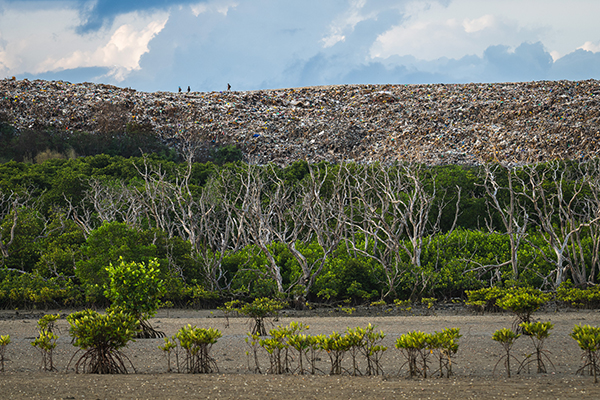
Threats Winner: ¨Paradise Buried¨ by Tom Quinney, Indonesia
I took this photo near Pesanggaran in southern Bali while on a birding tour looking for shorebirds at low tide. As we walked along the sand beside a chain of mangrove forests, I stumbled upon this towering pile of trash. It was a jarring sight, rising above the canopy of one of the island’s struggling mangrove ecosystems, in plain view but somehow hidden in plain sight. This appears to be a long-standing trash site, possibly once formal but clearly unmanaged. In the past, a major fire burned through the rubbish here, and to this day the landfill continues to grow, pressing against the edge of this delicate mangrove system. I was struck not only by the scale of the waste, but by the number of birds congregating around it, seemingly feeding from it, and the unexpected presence of people walking along the crest of the trash mound. Their small figures in the distance gave the scene a bizarre scale. Closer to my feet, among the sand and the crabs, were tyres, cans, and plastic debris. I noticed dead mangrove trees tangled in the middle layer of the forest, with young shoots planted in the foreground, likely part of a reforestation effort to combat the damage. The image felt layered in more than just its composition, the sky, the looming waste, the collapsing and regenerating trees, and the fragile shoots clinging to the tide line. I wanted the photo to serve as a wake-up call: an example of how mass tourism, consumerism, and poor waste infrastructure can collide in places that sell the idea of paradise. Shot on a Nikon Z8 with a 180–600mm lens to compress the layers I saw. This wasn’t what I intended to shoot, but it’s what I took away from this scene.
@tom_quinney
LANDSCAPES:
Black and White
Landscapes - Black & White Winner: ¨Take a Bow¨ by Vladimir Borzykin, Indonesia
This image steps into the realm of fine art photography. Using a long exposure, I transformed the moving sea into a motionless, reflective surface—like an ice skating rink. Against this backdrop stands a single, bent mangrove tree, its shape uncannily resembling a person taking a bow after a performance. It’s the only tree on this stretch of coast, and I found myself wondering what happened to the others. In that context, the bowed form became symbolic: a final act, a solitary performer acknowledging the end. @vladslandscapephotography
From the Air
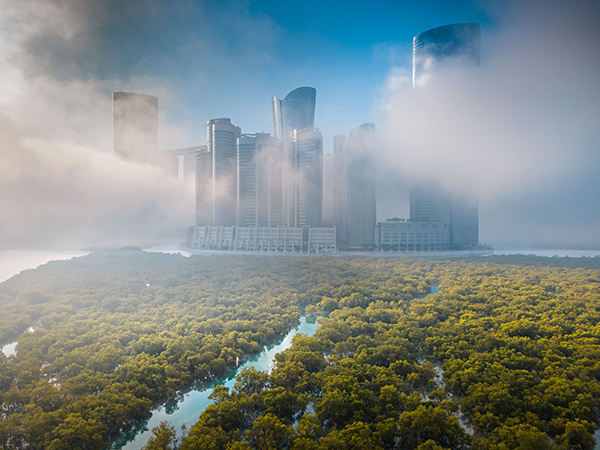
Landscapes - From the Air Winner: ¨Mangroves and Modernity¨ by Ahmed Badwan,
United Arab Emirates
The harmonious blend of mangrove nature with the modernity of the city — a captivating contrast where urban innovation meets the timeless rhythm of the wild.
@badwaan_
On the Ground
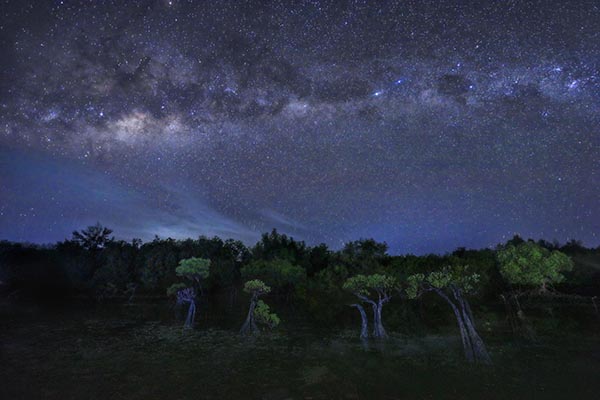
Landscape - On the Ground Winner: ¨Mangrove Under the Milky Way¨ by Gwi Bin Lim, Indonesia
This is Walakiri Beach. Not long after sunset, a breathtaking view of the Milky Way unfolded overhead. It's pristine where you can experience the spectacular night sky in all its glory.
@gwibinlim
PEOPLE:
Conservation and Restoration
People - Conservation & Restoration Winner: ¨Mangrove Honey Bees Make Land¨ by Ian Rock, Costa Rica
After a winding route through many narrow canals, fisherman Manuel carries a heavy bee hive off a boat to its new home within the buffer zone of the Terraba-Sierpe mangrove forest, the start of a new mangrove honey project for the community. Manuel and the others are local fishermen who live within the Terraba-Sierpe National Wetland, the largest mangrove forest in Costa Rica. For the local communities that live in this wetland, one of the poorest regions in Costa Rica, their primary source of income comes from fishing. Sadly fish and clam populations are declining from overfishing, loss of habitat, and climate change putting economic pressure on the communities. In order to build resilience for the community, Osa Conservation is working alongside the community to kick start a mangrove honey project, training fishermen like Manuel in beekeeping and business development. Flash to the moment this photo was taken. After months of training it was time to bring the bees to their new home within the buffer zone of the protected wetland. The only access is by boat and very difficult work transporting the heavy hives on unsteady vessels, particularly under the oppressive humid heat of tropical wetlands. Fast forward 6 months and the first batches of honey have been harvested, totaling close to 30kg. Excitement and pride is palpable in the mangrove beekeepers. The community members are working with a Costa Rican branding agency to develop their Mangrove Honey brand. Eventually the honey will be available commercially, first in the local lodges and shops of the Osa Peninsula and then further around Costa Rica. The honey is delicious and unique, with a distinct salty sweet flavor. Ideally in the future, this project has ripple effects, creating even more opportunities for a community with limited options, opportunities that are dependent on a prospering mangrove ecosystem rather than an over-harvested one. A resilient people and a resilient ecosystem.
@ianinthewild
Livelihoods
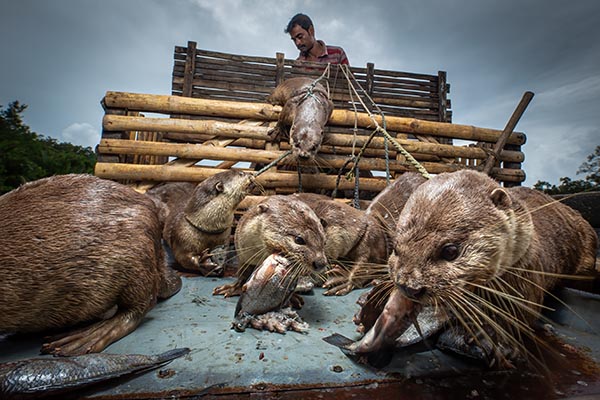
People, Livelihoods Winner: ¨Bhoben Biseash and his Otters¨ by Freddie Claire, Bangladesh
There are only a handful of otter fisherman left and their unusual method of fishing has been handed down from father to son for centuries. The trainer adult otters are teathered and the younger otters swim free. The otters chase fish from the muddy banks into the awaiting nets and after each fishing session get their share of the catch.
@shuttersoundfreddie
UNDERWATER:
Underwater Winner: ¨Low tide on hermit crab island¨ by Alex Pike, Australia
While Clibanarius taeniatus is one of Australia's more common hermit crab species, very little is known about it and I'm not sure it even has a common name. A study from 2003 found that its presence in large numbers generally indicates an environment that experiences higher freshwater flow than other marine intertidal regions. This is certainly true of the mangrove island I found at the entrance of Lake Macquarie which was absolutely teeming with these creatures. I visited this island at both low and high tides, and at low tide there were literally thousands of C.taeniatus feeding within the matrix of mangrove roots.
@alexjpike
CONSERVATION STORIES PORTFOLIO:
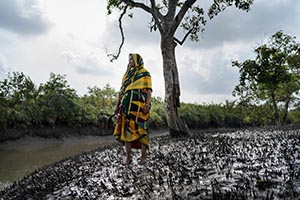
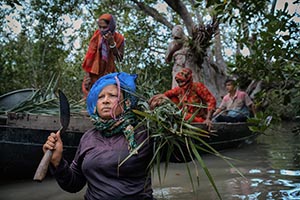
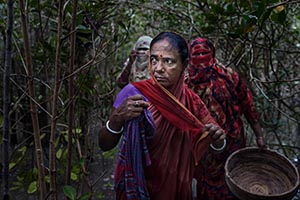
Conservation Stories Winner: ¨A Woman’s Fight in the Sundarbans Mangrove Forest¨ by Mohammad Rakibul Hasan, Bangladesh
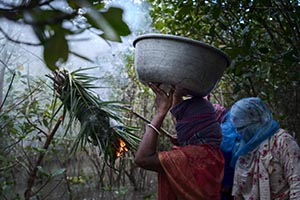
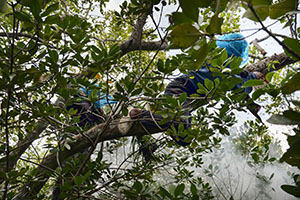
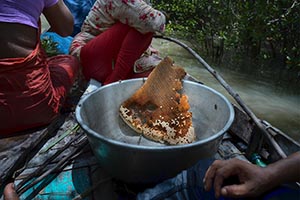
Shorbanu Khatun, a 45-year-old widow whose husband was killed by a Royal Bengal Tiger during honey hunting, never dares to enter the Sundarbans Forest to collect honey for her survival. Shorbanu, along with three other women who are also tiger widows, collectively hunts for honey in the deepest parts of the Sundarbans Forest. This perilous area is frequented by Royal Bengal Tigers, known for attacking and killing people, as well as pirates who kidnap honey collectors known as Mawalis. Karuna Rani, one of the few women in the Sundarbans who ventures into the forest to collect honey since her childhood, leads the way through the dense mangroves with Shorbanu. Aware of the ever-present threat of tigers, she prepares for the arduous task ahead. Alongside her fellow tiger widows, Karuna exhibits remarkable resilience and bravery, confronting both the dangers of wildlife and the challenging environmental conditions of their homeland. Karuna Rani holds a bowl ready to catch the honeycomb as her companion climbs a tree to cut the hive. Using a torch made from Gol leaves to smoke out the bees, these tiger widows bravely collect honey deep in the Sundarbans, facing numerous dangers from wildlife and environmental challenges. Shorbanu climbed up a tree in the Sundarbans Mangrove Forest to cut a beehive. She and her fellow women collaborators borrow money from the village Mahajan, who lends money to the Mawalis at high interest rates. Using smoke to ward off the bees, she carefully cuts the hive, her face shielded by a protective mesh. This dangerous task is a testament to her courage and determination as she works to support her family despite the ever-present threats of wildlife and environmental challenges. A fresh honeycomb rests in a bowl as Shorbanu and her fellow honey collectors take a moment to rest in the Sundarbans Mangrove Forest. This precious honeycomb, carefully cut from a tree, represents not only a vital source of income but also the immense risks these women undertake. @mohammadrakibulhasan
YOUNG PHOTOGRAPHER:
Young Photographer Winner: ¨Crocodile Galaxy by Nicholas Hess, United States
This image is one I’ve hoped to capture for the past 4 years living in Florida. Never whilst visiting this site did I get the chance before. But this day the stars literally aligned. At 2 AM, the Milky Way rose behind not one, but two crocodiles conducting some courting behavior. Seeing my opportunity I set up my tripod to utilize a long exposure to capture the Milky Way in my image. I then used a flash to freeze the crocodile’s subtle movement. After perfecting my settings, I shot a few images as the female appeared to circle the male and below. This one turned out to be my favorite.
@greatwhiterattlesnake
EMIRATES AWARD:
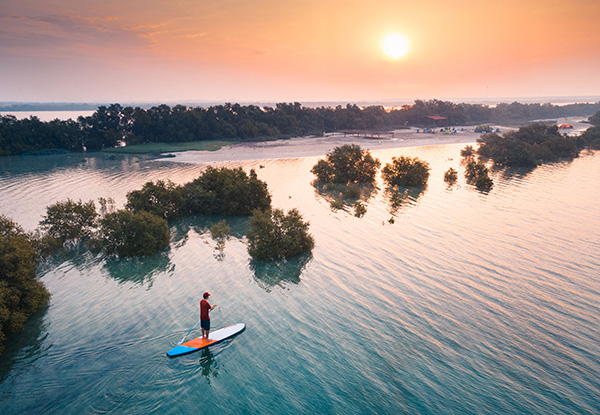
Emirates Award Winner: ¨Morning Serenity in Abu Dhabi¨ by Ahmed Badwan, United Arab Emirates
A serene morning kayak journey through the lush mangroves on one of Abu Dhabi’s tranquil islands — where nature whispers in stillness, and sunlight dances gently on the water’s surface, creating a scene of pure harmony.
@badwaan_
ARABIAN GULF AWARD:
Arabian Gulf Award Winner: ¨Cormorants welcoming the sunrise in the embrace of the mangroves¨ by Dr Mahdi Mohammad Gholoum, Qatar
This photo was taken on the shores of Qatar, where cormorants were resting after a long day of hard work and searching for food. As the sun rose, the birds stayed under the mangrove trees to rest and dry their wings from the water. The weather was very humid during the summer, which made photographing challenging, and my lens was malfunctioning at times. However, thankfully, we succeeded in capturing these beautiful and peaceful moments that reflect the natural balance of wildlife in the coastal mangrove environment.
@kuwait_environmental_eye
We invite audiences to explore the stories behind the winning images to learn more about the
importance of mangroves and global efforts to protect them. All winners will be live on our
website on 26th July. Visit: photography.mangroveactionproject.org
The Mangrove Photography Awards is organized by Mangrove Action Project (MAP), a
US-based non-profit dedicated to reversing the degradation and loss of mangrove forests and
their associated coastal ecosystems around the world by giving a voice to coastal communities,
restoration practitioners, and partner NGOs.
Through its grassroots, bottom-up approach, MAP strives to provide mangrove restoration and
conservation, education, training, and consulting that promote community-based, sustainable
management of coastal resources. Through this combined approach of action, advocacy, and
education, MAP can ensure mangrove forests are healthy for current and future generations.
Since the late 1990s Wildlife-film.com has been the leading source of information for the wildlife filmmaking industry worldwide. For over twenty years the site has been Google's number one ranking site for 'wildlife film' and related searches. Our site is viewed in over 195 countries. Our newsletter, Wildlife Film News, is read every month by thousands of people involved in wildlife filmmaking - from broadcasters and producers, to cameramen - we encourage readers to submit their news. We also serve as an online resource for industry professionals and services. Find producers, editors, presenters and more in our Freelancer section, and find out about festivals, training and conservation in Organisations. We encourage amateur and professional freelancers to join our network and welcome all wildlife-film related organisations to join our team.
Wildlife Film News is available every month straight to your Inbox! Subscribe here: